Unified Laboratory Frameworks Assess Wear Resistance in Running Shoe Soles, Cycling Tires, and Soccer Cleats
Xander Ludwig · Aug 3, 2026
Unified Laboratory Frameworks Assess Wear Resistance in Running Shoe Soles, Cycling Tires, and Soccer Cleats
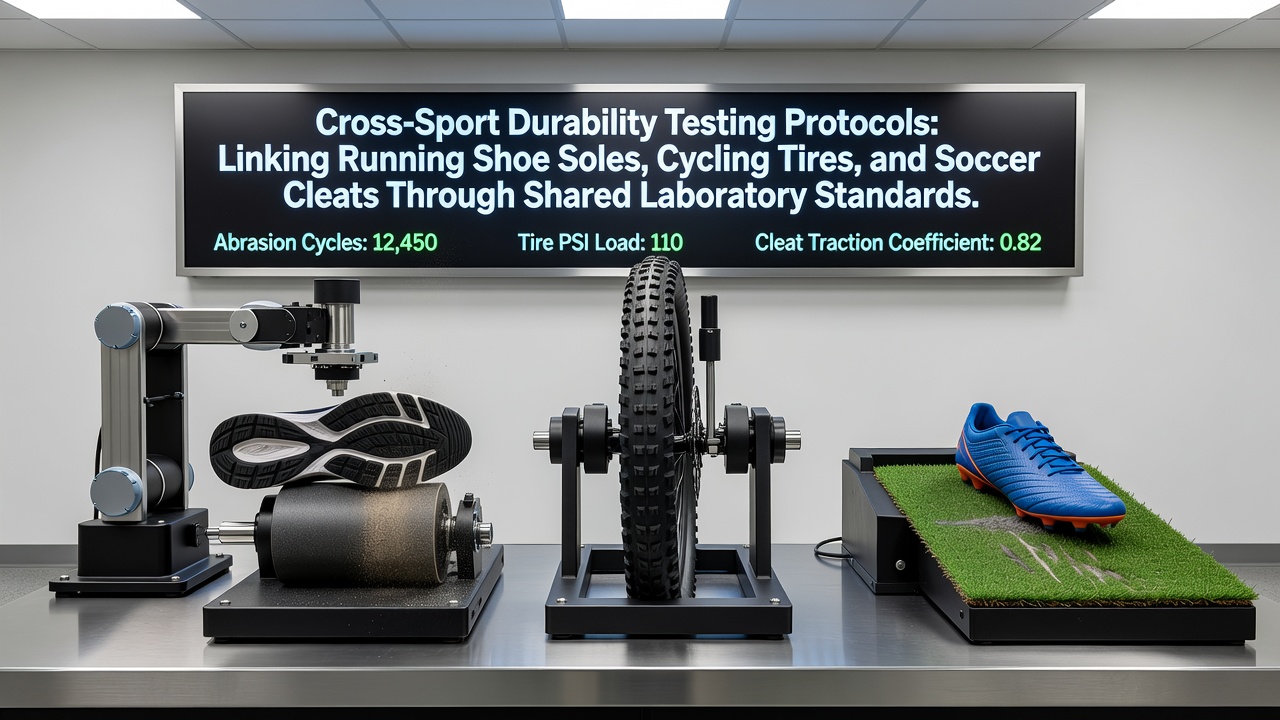
Researchers at multiple institutions have developed shared testing protocols that measure abrasion resistance, compression recovery, and surface interaction for running shoe soles, cycling tires, and soccer cleats, and these methods rely on standardized laboratory equipment rather than sport-specific simulations alone. Standards organizations coordinate procedures so that data from one category informs testing parameters for the others, creating consistent benchmarks across material types and usage environments.
Origins of Cross-Sport Standardization Efforts
Early attempts at durability assessment occurred separately within each sport, yet inconsistencies in measurement scales and environmental controls prompted collaboration among materials scientists and equipment manufacturers. By the mid-2020s laboratories adopted common reference surfaces and load cycles that replicate repeated ground contact without requiring full athletic motion capture. Data collected under these unified conditions allow direct comparison of compound hardness, tread geometry retention, and flexibility loss over thousands of simulated cycles.
Core Testing Parameters Applied Across Equipment Types
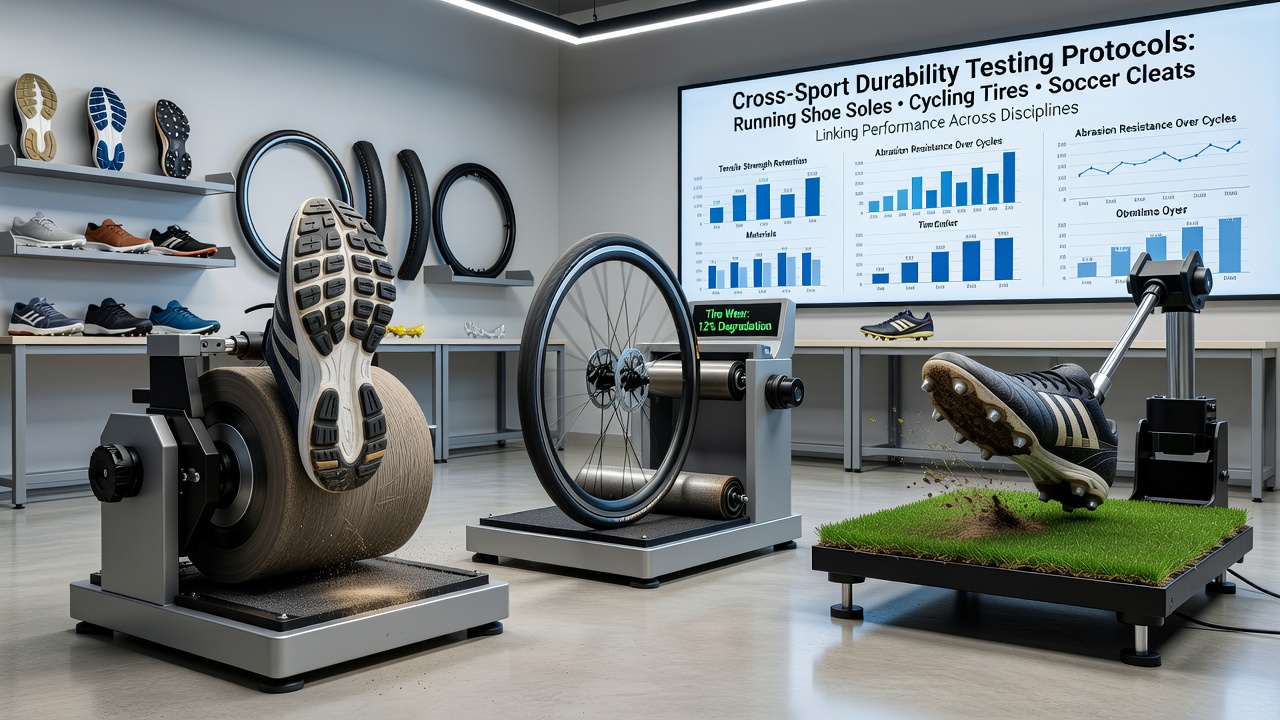
Protocols specify temperature ranges, moisture exposure intervals, and abrasive media calibrated to match typical playing surfaces, and operators record mass loss, groove depth reduction, and coefficient of friction changes at fixed intervals. Running shoe soles undergo repeated heel-to-toe rolling under vertical loads that mimic body weight distribution, while cycling tires experience tangential forces that replicate cornering stress, and soccer cleats face multidirectional shear that corresponds to cutting movements. The same rotary drum abrader and compression fixtures serve all three categories, which reduces equipment variation and permits statistical pooling of results from different material batches.
Role of Reference Materials and Calibration Standards
Calibration blocks made from standardized rubber compounds provide baseline wear rates that laboratories verify before each test series, and these blocks undergo periodic verification at national metrology institutes. Figures released by ASTM International indicate that inter-laboratory repeatability improved after adoption of shared reference specimens, with coefficient of variation dropping below five percent for mass-loss measurements. Researchers adjust load magnitudes and cycle counts according to sport-specific usage profiles yet maintain identical environmental chambers and data-logging software across sites.
Integration of Field Data with Laboratory Controls
Observatories note that field-collected mileage data from athletes and cyclists help refine laboratory cycle targets, while laboratory results in turn guide selection of field test routes that stress particular failure modes. In one documented program, tire compounds selected after accelerated drum testing showed twenty percent longer service life on mixed-surface routes compared with earlier formulations that had passed only sport-specific checks. Similar feedback loops apply to cleat stud retention and midsole cushioning response, where shared metrics highlight material interactions not visible in isolated tests.
Regional Contributions to Protocol Refinement
European Committee for Standardization working groups supplied initial surface texture specifications that later informed North American and Asia-Pacific laboratories, and Australian research centers contributed humidity-controlled abrasion sequences that address tropical training conditions. A 2025 report from the Commonwealth Scientific and Industrial Research Organisation described how these combined inputs reduced discrepancies between indoor predictions and outdoor outcomes for multi-sport athletes. Laboratories now schedule round-robin sample exchanges every six months to maintain alignment across continents.
Developments Scheduled for August 2026
Updated calibration procedures scheduled for release in August 2026 will incorporate digital twin modeling that links physical test rigs with finite-element simulations of contact stresses, and participating laboratories plan to validate these models against existing wear databases before full implementation. The revisions also introduce optional high-speed imaging modules that capture particle ejection patterns during abrasion, providing additional data points that correlate with long-term surface degradation across all three equipment categories.
Conclusion
Shared laboratory standards now provide a common language for durability evaluation that connects running shoe soles, cycling tires, and soccer cleats through consistent measurement techniques and reference materials. Continued coordination among standards bodies, academic groups, and manufacturers supports incremental improvements that reflect real-world usage patterns while maintaining comparability across geographic regions and testing facilities.